
Wednesday, 24 June 2026 / 12:30 pm – 1:30 pm AEST
Presented by Seed Bank staff across the Partnership’s national network.
Celebrate 15 years of saving seeds with the Australian Seed Bank Partnership. In this special anniversary PlantChat webinar, we’ll reflect on a decade and a half of national collaboration to safeguard Australia’s native plant diversity through seed banking, science and knowledge sharing.
Hear from seed experts across the country as they share their experiences! From working on the ground to collect and conserve seeds, to advancing research and supporting restoration and recovery efforts. Together, we’ll highlight key achievements, explore how a coordinated national approach has strengthened Australian plant conservation, and discuss the challenges and opportunities that lie ahead.
This is also a chance to look forward. As pressures on Australia’s flora continue to grow, we’ll consider what the next 15 years of seed conservation could look like, and how partnerships, innovation and community support will play a role.
Wednesday, 29 April 2026 / 12:30 pm – 1:30 pm AEST
The Australian Virtual Seed Bank (AVSB) is a national, open-access portal bringing together seed collection and germination data from conservation seed banks across Australia. But what does it actually do, and how can it support your work? In this webinar, we’ll take you inside the AVSB to explore its features, functionality, and real-world applications. From interactive maps of seed collections to downloadable datasets and threatened species insights, you’ll learn how the portal can support research, restoration planning, and conservation decision-making. Whether you’re a policy maker, land manager, seed collector, or simply curious about Australia’s native flora, this session will show you how to get the most out of the portal and why this growing national resource matters.
Presented by Mr Jack Brinkman from the Atlas of Living Australia
 Jack Brinkman is a software engineer with the Atlas of Living Australia (ALA), where he contributes to the design and delivery of robust, user-focused biodiversity platforms. Working within the Apps team, he helps build and maintain systems that enable researchers, government, and citizen scientists to access and share trusted environmental data with ease.
Wednesday, 27 August 2025 / 12:30 pm – 1:30 pm AEST
Since detection in a southern suburb of metropolitan Perth in 2021, Polyphagous Shot Hole Borer (PSHB) has emerged as a significant plant pest, impacting urban canopy, amenity landscapes and natural systems. Join Dr Jason Stevens (Director, WA Botanic Gardens) and Chelsea Payne (Curator, Arboriculture) for a discussion on the impacts of PSHB on the Western Australian Botanic Garden, lessons learned from three years of surveillance and treatment of PSHB, what’s next for PSHB management at Kings Park, and how to build adaptive networks of plant professionals to safeguard trees across Australia.
Presented by Dr Jason Stevens and Chelsea Payne from the Botanic Gardens and Parks Authority
 Dr Jason Stevens is the acting Director of the Western Australian Botanic Garden at BGPA. Prior to stepping into this role in mid-2025, he served as Program Leader of Kings Park Science, where he led cutting-edge research in restoration ecophysiology, native plant biology, and ecosystem rehabilitation. Jason brings a science-driven vision to the WA Botanic Garden, aiming to enhance public engagement, conservation outcomes, and the integration of research into horticultural practice.
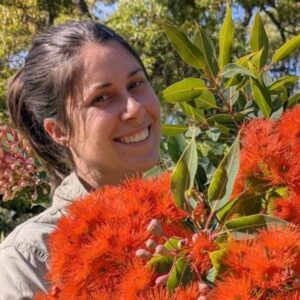 Chelsea Payne is Curator of Arboriculture at the Botanic Gardens and Parks Authority, based in Kings Park & Botanic Garden in Perth. She leads a dedicated team of qualified arborists committed to best-practice tree stewardship, with a strong emphasis on evidence-based tree management in both the world-class Botanic Garden and surrounding urban parklands.
Wednesday, 28 May 2025 / 12:30 pm – 1:30 pm AEST
Plants are the foundation of life on Earth, yet we still have major gaps in our understanding of where they occur, how they’re changing over time, and what that means for biodiversity and ecosystems. This talk dives into the power of iNaturalist, the world’s largest citizen science platform for plant occurrence data. You’ll learn how to take informative plant photos, upload observations, explore the wealth of plant data available on the platform, and contribute to identifying records for others. Whether you’re a seasoned botanist or a budding naturalist, watch to find out how every snap of a flower can help build a richer picture of our natural world.
Check out resources mentioned in the webinar:
- Citizen scientists can help save Australia’s threatened species if we give them more direction
- Thousands of our native plants have no public photographs available. Here’s why that matters
- Citizen science records are fuelling exciting discoveries of new plant species
- Rapid progress on the photographic documentation of Australia’s flora
- Photographs as an essential biodiversity resource: drivers of gaps in the vascular plant photographic record
- Curating protected area-level species lists in an era of diverse and dynamic data sources
Presented by Thomas Mesaglio, PhD candidate at the University of New South Wales, Sydney

Thomas Mesaglio is a PhD candidate at the University of New South Wales, Sydney, working on improving our understanding of Australia’s flora by integrating professional and citizen science data. He regularly organises, leads and participates in BioBlitzes, and is a site administrator for iNaturalist Australia.
Wednesday, 18 September 2024 / 12:30 pm – 1:30 pm AEST
The Myrtle Rust pathogen is causing serious decline in 40 to 50 species. It is not treatable in the wild at any practical scale. Survival and recovery of many of these species is likely to depend entirely on screening for rust tolerance traits, and breeding these back into wild types for re-introduction. Breeding for disease resistance is standard practice in agriculture, but is relatively new in plant conservation; nevertheless, successful overseas precedents exist. The process will require significant investment, organised meta-collections, and large standing arrays of live plants for screening trials. To compound the problem, many affected species have seeds that are either known or thought to be unsuited for orthodox storage conditions, or are short-lived, so seed production areas are also needed. These requirements for an effective Myrtle Rust response come on top of growing demands on botanic gardens for many other conservation commitments – for more orthodox translocations, and for climate change response. Existing seed and tissue banks, and regional and metropolitan botanic gardens, are already all playing a role in this new challenge for plant conservation, but a qualitative growth of facilities and workforce transcending existing institutions is needed. Adjusting our thinking and planning to this need, and finding adequate and sustained resources, is a greater challenge than the technical problems.
Presented by Bob Makinson, Australian Network for Plant Conservation
 Bob Makinson is a plant taxonomist and conservation botanist. When the plant disease Myrtle Rust was first detected in Australia in 2010, Bob was President of the Australian Network for Plant Conservation (ANPC). Little information and expertise on this pathogen was easily available to the conservation and land management sectors, where the pathogen would have severe effects. He began building bridges to knowledge-holders in the forest health and plant pathology sectors where most of the knowledge resided. By mid-2011 he had designed and launched a series of awareness and training workshops on Myrtle Rust for the environmental sector, eventually delivering 40 nationwide in formats ranging from one-day to seminar, with an accompanying manual on myrtle rust recognition, risk assessment and management. These workshops helped transfer specialist knowledge into the wider conservation arena. Bob wrote a comprehensive review of the environmental effects of myrtle rust in Australia in 2018, with funding from the Australian Government’s National Environmental Science Program and the Plant Biosecurity Cooperative Research Centre, accompanied by a National Action Plan for Myrtle Rust (2018, 2020) – all these are available here. Alongside this, and working closely with State government agencies, he participated in the endless task of securing piecemeal short-term funding and stitching it into the beginnings of a coherent long-term program for some of the worst-affected species. An extended phase of ex situ conservation is a key part of this process, and (along with other conservation demands on ex situ institutions) is already testing our national capacity. In 2022 Bob received a Commonwealth Australian Biosecurity Award in the Environmental Biosecurity category.
Wednesday, 17 July 2024 / 12:30 pm – 1:30 pm AEST
Large quantities of diverse native seeds are required to scale up global restoration efforts. However, it remains unclear for many ecosystems how the diversity of available seed in commercial stocks reflects the composition of the ecosystems where vegetation is being remade. This talk will explore existing shortfalls in the diversity of seed presently available for use in restoration across Australia and identifies gaps in the seed supply chain. Additionally, we will cover methods for optimising species diversity despite these constraints. We hope this talk sparks improved collaborations between stakeholders involved in nature repair across Australia to strengthen the seed supply chain and work together to repair diverse vegetation.
Check out resources mentioned in the talk:
Presented by Dr Samantha Andres, Postdoctoral Research Fellow, Hawkesbury Institute for the Environment, Western Sydney University
 Sam is an ecologist with a broad interest in the conservation, restoration and management of natural ecosystems. Sam’s work involves using ecological theories to approach applied problems in ecology with an aim to generate knowledge that can be directly applied to policy and practice. Sam also has a deep interest towards including societal and cultural values in conserving and restoring ecosystems. While her research spans a variety of ecosystems, Sam tends to focus on themes which include species traits, functional diversity, community assembly, global change, disturbance biology, fire ecology, and plant soil interactions. With a focus sustainability, Sam works to ensure that ecological conservation and restoration efforts are guided by sound science and holistic principles, fostering a harmonious relationship between nature and society. You can read more about Sam’s research here.


